

An opening in the schedule can quickly trigger the same conclusion for a dental clinic: we need more patients.
That may mean increasing the advertising budget, investing more heavily in SEO, launching another campaign, or finding a new way to generate leads. More demand can certainly be the answer, but it shouldn’t always be the first one.
Before investing more to bring new opportunities into your clinic, it’s worth looking at what happens to the opportunities you already have.
Improving dental marketing ROI is not simply a matter of attracting more prospective patients. Your clinic may already have people finding you through Google, visiting your website, calling your team, requesting appointments, receiving treatment recommendations, and entering your patient database. The bigger issue may be how many of those opportunities disappear before they turn into appointments, treatment, and revenue.
At Gargle, we view dental marketing as part of a larger growth system. Marketing creates opportunities, but what happens next determines their value. Missed calls, scheduling friction, abandoned website visits, cancellations, unscheduled treatment, inactive patients, and incomplete tracking can quietly drain growth from a clinic that otherwise appears to have a demand problem.
Before you turn up the marketing, it may be worth finding out where you’re leaking growth.
Better Dental Marketing ROI Starts After the Lead

Marketing reports tend to focus heavily on what happens at the beginning of the patient journey. Impressions increase. Website traffic goes up. An ad receives clicks. The phone rings.
Those are positive signals, but they aren’t the end goal.
A prospective patient still has to move through an entire journey:
Search → Website Visit → Inquiry → Appointment → Patient → Treatment → Revenue
At each stage, there is another opportunity for the patient to continue forward or disappear.
Suppose your clinic generates 100 qualified patient opportunities during a month. Some people may leave the website without contacting you. Others may call when no one is available to answer. Some will schedule but cancel. Others will attend a consultation but never schedule recommended treatment.
By the time you reach actual production, the number can look very different from the 100 opportunities you started with.
The instinct may be to generate another 100.
But if the same leaks remain, increasing demand may simply send more opportunities through a system that is already losing them.
A better approach to dental marketing ROI considers both sides of the equation: How effectively are you generating demand, and how effectively is your clinic converting the demand you already have?
Leak #1: Prospective Patients Can’t Reach or Schedule With You

A prospective patient has already done a considerable amount of work before contacting a dental clinic.
They may have searched for a dentist, looked at several clinics, read Google reviews, explored your services, researched your dentists, and decided your clinic appears to be the right fit.
Then they call.
No one answers.
The team may be helping patients. The call may arrive during lunch or after regular clinic hours. The prospective patient might reach voicemail, wait too long on hold, or leave a message that doesn’t receive a timely response.
Even an answered call can be lost if the scheduling process becomes too complicated.
The important point is that this isn’t necessarily a lead-generation problem. Marketing may have worked exactly as intended. It helped someone discover your clinic, built enough interest for them to choose you, and motivated them to take action.
The breakdown happened afterward.
That’s why clinics should look beyond total call volume. How many calls are answered? When are calls most frequently missed? Which marketing sources generate high-intent phone calls? How many of those callers ultimately schedule?
Online scheduling can help capture another segment of prospective patients, particularly those researching dental care outside clinic hours or those who simply prefer digital scheduling.
A lead you paid to generate has no value if the patient can’t take the next step.
Before investing more money to make the phone ring, make sure the opportunities already reaching your clinic are being captured.
Leak #2: Scheduled Patients Don’t Become Actual Visits

A schedule can look full days or even weeks in advance and still develop holes when appointment day arrives.
Last-minute cancellations and no-shows are a normal part of operating a dental clinic, but high rates can obscure what is actually happening with your marketing.
Imagine Campaign A generates 50 new-patient appointments while Campaign B generates only 35. If those are the only numbers you review, Campaign A appears significantly more successful.
Now imagine only 26 of Campaign A’s patients arrive, while 32 of Campaign B’s patients show for their appointments.
Suddenly, the story changes.
This is why the quality of an appointment matters just as much as the quantity of appointments generated.
Confirmation systems, appointment reminders, convenient rescheduling, and short-notice processes can help reduce the impact of cancellations. Clinics can also learn a great deal by looking for patterns. Perhaps patients from one source have a significantly higher no-show rate. Maybe a long wait between the initial call and available appointment time is contributing to cancellations.
The goal isn’t to eliminate every cancellation. That’s unrealistic.
The goal is to understand whether the patients you’re working hard to acquire are actually making it into the chair.
Leak #3: Your Website Gets Attention but Not Action

Getting someone to a dental clinic’s website requires work.
SEO helps the clinic appear when people search for dental care. Paid advertising creates visibility for priority services. Social media builds awareness. Online reviews and local search profiles help patients discover and evaluate their options.
But website traffic isn’t the finish line.
If prospective patients consistently visit the site without calling, booking, or submitting an appointment request, the website itself may be leaking opportunities.
Sometimes the problem is technical. The site loads slowly. The phone number isn’t easy to find on a mobile device. Buttons don’t work properly. Online scheduling is difficult to access.
Other times, the problem is persuasion.
The website explains what a dental implant is but gives the patient no reason to choose this particular clinic for one. The dentists aren’t prominently introduced. Patient reviews are difficult to find. Payment information is unclear. The service page sounds almost identical to every other clinic in the market.
Patients considering significant treatment need more than information. They need confidence.
They want to understand who will provide their care, what makes the clinic different, what other patients say, what treatment may involve, and how to get started.
That is why website conversion deserves as much attention as website traffic.
If 1,000 qualified people already visit your clinic’s website every month, attracting another 1,000 visitors is one potential growth strategy.
Getting more value from the first 1,000 is another.
At Gargle, we believe a dental website should do much more than establish an online presence. It should help transform patient interest into action.
Leak #4: Existing Patient Opportunities Are Being Overlooked

One of the largest potential sources of clinic growth may already be sitting inside your patient database.
Consider the patient who received a treatment recommendation but never scheduled. The person who attended an implant consultation and wanted more time to decide. The patient who hasn’t returned for continuing care. Or the clear aligner candidate who was interested but couldn’t move forward at the time.
These patients are fundamentally different from someone discovering your clinic for the first time.
They already know you.
Your clinic has already invested in acquiring them, building a relationship, and earning some level of trust. In many cases, the patient may already understand that treatment is needed.
Yet dental clinics can devote substantial marketing resources to acquiring strangers while doing relatively little to reconnect with patients who are already familiar with the clinic.
This opportunity may be particularly relevant in Canada as access to dental coverage continues to evolve. The Canadian Dental Care Plan has expanded access to oral health services for millions of eligible Canadians who do not have access to private dental insurance. A patient who postponed care previously because of financial concerns may be in a different position today.
That does not mean sending every inactive patient the same promotional message.
Reactivation should be relevant.
Someone with unscheduled restorative treatment may benefit from additional education about why completing treatment matters. A patient concerned about cost may need clearer information about coverage, payment options, or financing. Someone overdue for continuing care may simply need a reminder and an easy path back onto the schedule.
New patients are important, but acquisition is only one side of growth.
Sometimes the next opportunity isn’t someone who has never heard of your clinic. It’s someone who already chose you once.
Leak #5: You Can’t Connect Marketing to Patient Outcomes

The final leak can be the hardest to recognize because the clinic may still be getting results.
The problem is that no one knows exactly where those results came from.
A monthly report may show growing impressions, improving keyword positions, more website sessions, hundreds of clicks, and dozens of conversions.
All of that data has value.
Eventually, however, every clinic owner should be able to ask a much more practical question:
Is our marketing actually helping the clinic grow?
Answering that requires connecting marketing activity with what happens in the real patient journey.
Where did an inquiry originate? Did the patient call, complete a form, or book online? Was the call answered? Did the person schedule? Did they arrive for the appointment? What type of care were they seeking?
The more clearly those pieces connect, the better a clinic can understand its dental marketing ROI.
Without that visibility, decision-making becomes guesswork. A clinic could stop investing in a channel that quietly produces some of its most valuable patients. It could also continue funding a campaign that generates an impressive volume of leads but very little meaningful treatment.
Tracking isn’t about creating a bigger report.
It’s about creating better information for the decisions that affect clinic growth.
Put Your Dental Clinic Through a Growth Leak Test
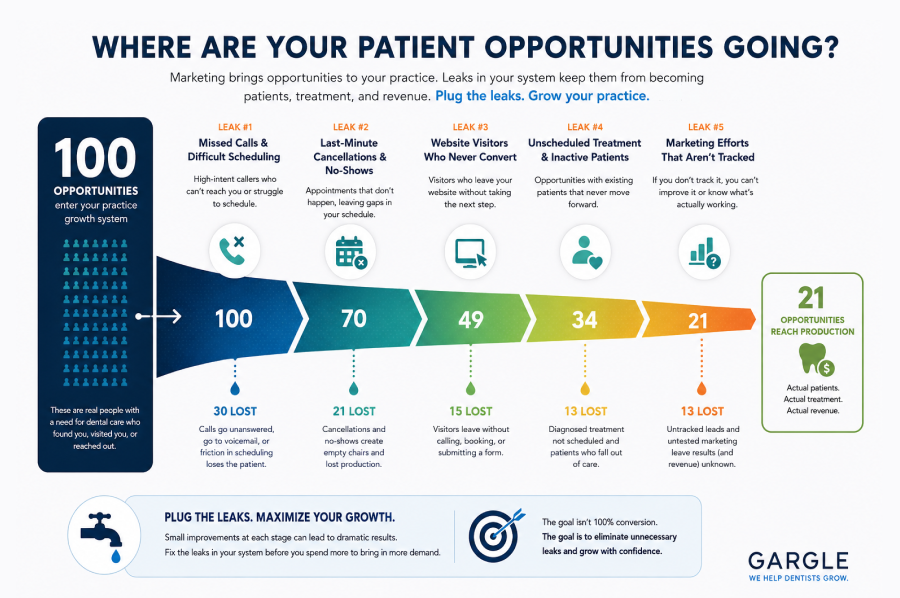
Finding potential leaks doesn’t require an enormous analytics project. A clinic can learn a great deal simply by looking carefully at what happened over the previous month.
How many prospective patient calls went unanswered? How many inquiries became appointments? How many scheduled new patients actually arrived? What percentage of website visitors took a meaningful action? How much recommended treatment remains unscheduled? How many patients are overdue for continuing care? Can you identify which marketing sources are generating new patients?
Then ask the most important question:
Can you connect your marketing investment to meaningful patient outcomes?
If several of those questions are difficult to answer, you’ve identified an important place to start.
That doesn’t mean the goal should be 100% conversion. Every clinic will have people who don’t schedule, patients who cancel, website visitors who leave, and treatment plans that don’t move forward.
The objective is to identify avoidable loss.
Where is unnecessary friction making it harder for a patient to move forward? Which improvements could recover more opportunities? Where could a relatively small change create a meaningful difference in revenue?
Those are often more valuable questions than simply asking how to generate another hundred leads.
More Leads Aren’t Always the First Solution

There are plenty of situations where a dental clinic genuinely needs more demand.
A new clinic needs to establish itself in its community. A dentist who has added implant treatment may need to reach patients actively searching for that service. A clinic entering a growth phase may need stronger SEO, paid advertising, content, reputation management, or other strategies to expand its reach.
Generating new demand remains an important part of dental marketing.
It simply shouldn’t happen in isolation.
At Gargle, we look at dental marketing as a connected growth system. Search visibility, website traffic, calls, and leads matter, but so do conversion, scheduling, patient experience, retention, reactivation, and tracking.
When you examine the entire journey, you can begin to see whether the clinic truly has a demand problem or whether valuable opportunities are being lost somewhere along the way.
If your schedule has openings, you may need more marketing.
But you may also already have more opportunity than you realize.
Before asking, “How can we get more patients?”, start with a different question:
“What is happening to the opportunities we already have?”
Finding and fixing those leaks can help your clinic get more value from the demand it already generates, improve dental marketing ROI, and build healthier, more sustainable growth.